Living Room Rug Size: How to Choose the Right Rug for Your Layout
Choose a living room rug by measuring your seating, testing furniture placement and comparing sizes. Includes an 84-inch-sofa example and a buying checklist.
By Shelf & Sill5 min read
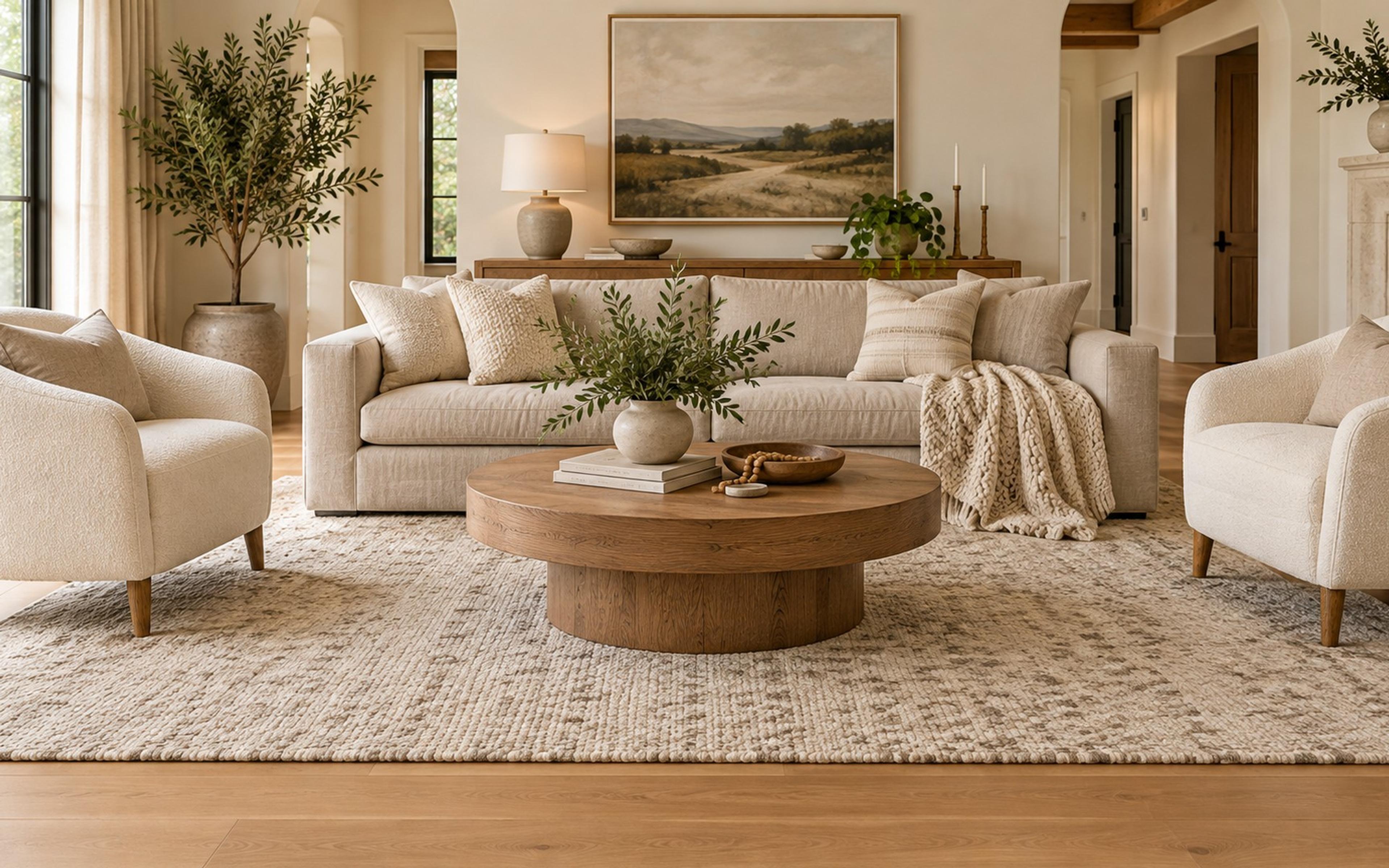
Styled inspiration · products may vary
The most useful starting point for a living room rug is the furniture it needs to connect. Measure the sofa and chairs, choose where their legs should sit, then test a rug outline on the floor. A room-size label such as “small living room” cannot tell you whether a particular rug will reach your chair.
For many layouts, putting the front legs of the sofa and chairs on the rug is a practical compromise between a tiny rug under the coffee table and a large rug under every piece. You can start with the furniture you already own; moving it slightly may solve the problem before you buy anything.
1. Measure the seating group first
Write down the sofa's overall width, including its arms. Next, measure from the sofa to the farthest chair that should share the rug. Mark doors, floor vents and the route people use through the room. These measurements set the usable area.
Measure the leg positions as well as the upholstery. A sofa with inset feet may sit securely on a rug even when its arms extend farther. A swivel chair needs enough covered area for its base through its normal movement, rather than only when it faces the sofa.
Keep the main walking route outside the seating group where possible. A larger rug should connect furniture, rather than force people to step over a curled edge on their way to the door.
2. Choose a placement before choosing a size
Front legs on
The front feet of the sofa and each main chair sit comfortably inside the rug's edge. Avoid balancing feet on the binding. This placement suits many apartments and rooms where the sofa backs against a wall.
All legs on
The entire seating group fits on the rug, with some rug visible around it. This gives a floating furniture arrangement a clear boundary. Measure to the back feet of the chairs; the sofa alone does not determine the required depth.
Coffee table only
A small rug can work as an accent, especially in a tiny sitting nook. Check that its edges sit deliberately within the seating group. If it looks stranded between the furniture, try moving the seating closer before replacing it.
Pottery Barn's rug placement guide also uses front-leg placement across different seating arrangements. The useful principle is furniture contact, rather than one universal rug size.
3. Compare standard sizes in the correct orientation
Treat the following as candidates to tape out, rather than sizes automatically assigned to particular rooms. Metric measurements are approximate; check the actual listing.
- 5 × 8 feet, about 152 × 244 cm: useful to test with a loveseat or compact seating group. Its five-foot depth may not reach chairs opposite the sofa.
- 6 × 9 feet, about 183 × 274 cm: offers more depth while still fitting some smaller rooms.
- 8 × 10 feet, about 244 × 305 cm: a useful candidate for a sofa and additional seating.
- 9 × 12 feet, about 274 × 366 cm: worth testing for a larger group or sectional, provided it leaves doors and routes usable.
Rotate the proposed size on your sketch. An 8 × 10-foot rug gives a different result with its ten-foot side along the sofa than with its eight-foot side along it.
Worked example: an 84-inch sofa
Imagine an 84-inch-wide sofa, a coffee table and one chair. You want the sofa's front feet and the chair's front feet on the rug.
A 5 × 8-foot rug has a 96-inch long side. Centered along the sofa, that leaves (96 − 84) ÷ 2 = 6 inches beyond each arm. That may look reasonable across the sofa, but its 60-inch depth still needs testing against the chair.
A 6 × 9-foot rug has a 108-inch long side, leaving 12 inches at each sofa end. Its 72-inch depth may connect the chair more comfortably. An 8 × 10-foot option offers still more room, but could intrude into a doorway.
The decision is therefore not “an 84-inch sofa needs this rug.” It is “which outline reaches the furniture and preserves the route through this particular room?”
4. Do a tape test before ordering
Use a floor-safe marking method, testing any tape on an inconspicuous spot first. Mark the outside edges of two candidate sizes. Then leave the furniture in its everyday position.
- Sit down and get up from every seat.
- Open nearby doors fully.
- Move a swivel chair and extend a recliner, if you have them.
- Check that the coffee table sits completely inside the outline.
- Photograph the layout from the entrance to compare its proportions.
If the larger outline works better but costs more, compare simpler patterns or materials in that size. Buying a smaller rug you already know will not connect the furniture is rarely a useful saving.
Sectionals, narrow rooms and open plans
For a sectional, include the chaise in the footprint. Check the feet at both ends instead of centering the rug only on the main sofa section. An asymmetrical placement can look balanced when it follows the full seating arrangement.
In a narrow room, preserve the route along one side. There is no need to center the rug on the entire room if the furniture is grouped off-center. In an open plan, center it on the living zone rather than trying to stretch it toward the dining table.
A visible strip of floor can frame the rug, but do not sacrifice a working furniture layout to achieve an identical border on every wall.
Can you keep a rug that is too small?
First try it in a reading corner, bedroom or another smaller zone. You can also test a larger flat base rug underneath it. Include the base rug and suitable pad in the total cost before deciding that layering is cheaper.
Check the combined thickness and the edges where people walk. Two rugs that slip or create a raised edge are not a successful layout, however good the colors look.
Before you buy
Confirm the actual dimensions, pile height, cleaning method, return conditions and compatibility of the rug pad with your flooring. Measure door clearance with the pad included. A washable rug also needs to fit the washing equipment specified by its maker.
If you are choosing the rest of the room's finishes, see how to mix wood tones. A rug can create a useful visual break between a wood floor and a different wood coffee table.
Quick answers
Is a 5 × 8 rug always too small?
No. It can work with compact seating. Check the depth and furniture contact rather than rejecting it by size alone.
Should the rug be wider than the sofa?
Some visible extension beyond the sofa usually looks balanced. The exact amount depends on the chair positions and the room; test it instead of treating a number as compulsory.
Do all furniture legs need to be on it?
No. Front legs on is a useful option. What matters is a deliberate, stable placement that connects the seating you want to group.
You might also like
Living Room
How High to Hang Art Above a Couch (Simple Guidelines That Work)
How high to hang art above a couch: the 8 to 10 inch gap, the eye-level center rule, how wide art should be, and fixes for low sofas and tall ceilings.
Living Room
How to Mix Wood Tones: 10 Simple Rules for a Warm, Collected Room
Make mixed wood furniture feel intentional with a daylight check, a worked oak-and-walnut example and practical fixes that start with pieces you already own.
Living Room
5 Simple Ways to Make Your Living Room Feel Cozy
Transform your living room into a warm, inviting sanctuary with these 5 simple styling tricks and cozy accent pieces.